

Pakistan is once again confronting a severe and rapidly evolving terrorism challenge. The Pakistan Risk, Incident, and Security Monitor (PRISM) 2025, published by the Center for Security, Strategy & Policy Research (CSSPR), presents a stark picture of the country’s internal security landscape, revealing a sharp rise in attacks, casualties, and militant activity across multiple regions.
The findings leave little room for ambiguity: terrorism in Pakistan is not only increasing in frequency, but also becoming more organized, technologically advanced, and strategically ambitious.
The Scale of the Threat
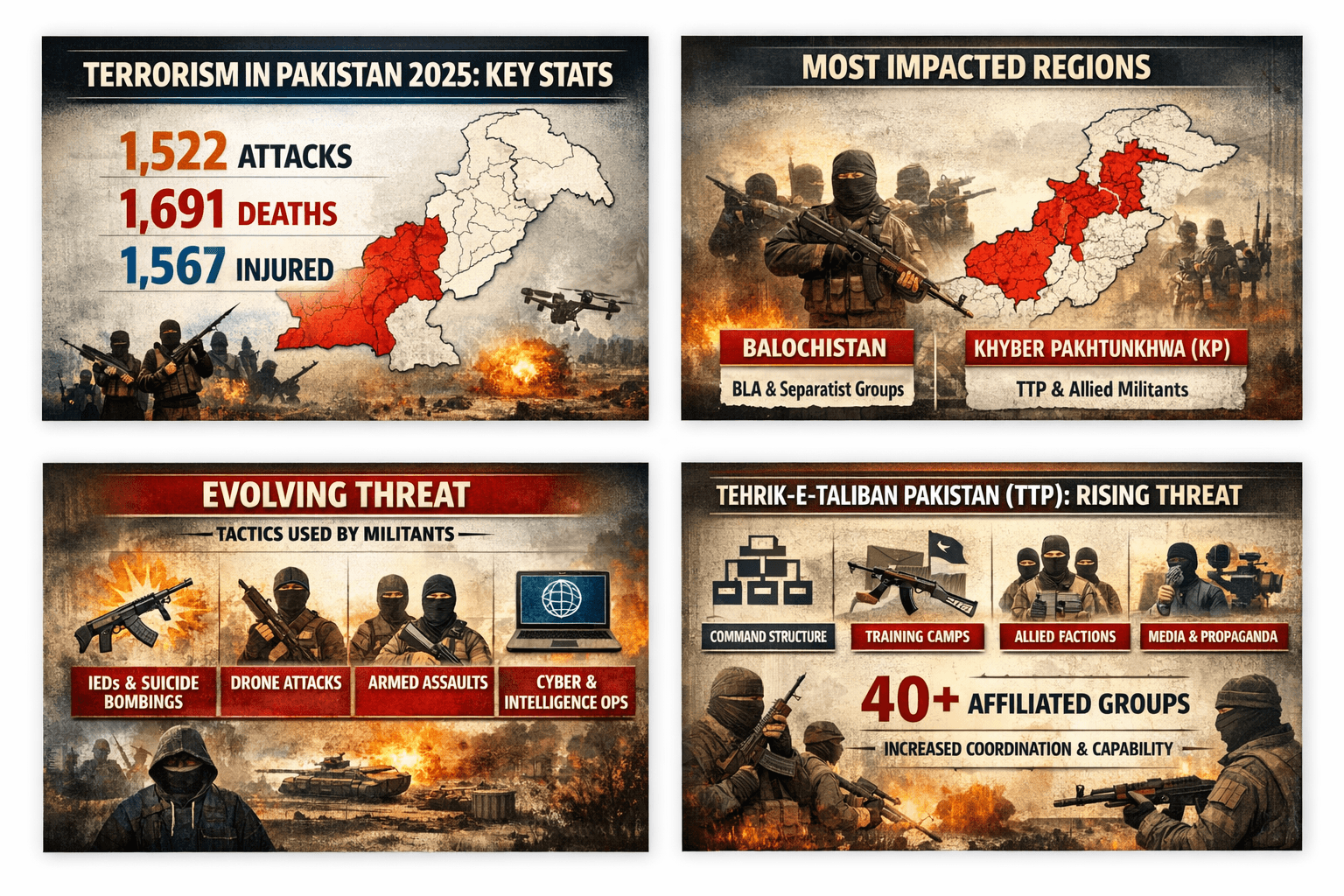
Between January and September 2025, Pakistan experienced 1,522 terrorist incidents, leading to 1,691 deaths and 1,567 injuries
PRISM Vol. 1 - Report
These numbers already surpass those recorded in the entirety of 2024, confirming that the country is on track to witness one of its deadliest years in over a decade.
This surge follows a clear post-2021 pattern. After the U.S. withdrawal from Afghanistan, militant groups operating along Pakistan’s western frontier found renewed space to regroup, rearm, and reorganize. What had appeared to be a declining threat after major counterterrorism operations has now re-emerged with greater intensity.
Balochistan and KP: Bearing the Heaviest Burden
The PRISM data shows that Balochistan and Khyber Pakhtunkhwa account for nearly 95 percent of all terrorist incidents. In Balochistan, districts such as Kech, Kalat, Khuzdar, and Awaran have become persistent hotspots of violence.
Baloch separatist groups—particularly the BLA and its allied networks—have escalated attacks on security forces, economic assets, and transportation infrastructure. These actions are designed not only to inflict casualties but also to challenge the state’s control and disrupt development projects.
In Khyber Pakhtunkhwa, the Tehrik-e-Taliban Pakistan (TTP) continues to dominate the militant landscape. Districts like Bannu, Bajaur, Lakki Marwat, and North Waziristan remain under constant threat, reflecting the enduring strength of militant sanctuaries and the limits of temporary security gains.
Changing Tactics and New Threats
A key warning from the PRISM report is the changing nature of terrorist operations. Militants are increasingly using drones, remote-controlled explosives, coordinated ambushes, suicide bombings, and targeted killings to maximize impact.
The use of modern technology, improved intelligence gathering, and digital communication platforms indicates that terrorist groups are learning, adapting, and innovating faster than before. These developments pose serious challenges for law enforcement and intelligence agencies operating under conventional frameworks.
The TTP’s Revival and Reorganization
One of the most concerning trends highlighted in the report is the organizational revival of the TTP. Under Noor Wali Mehsud, the group has shifted from a fragmented network into a more disciplined and centralized organization, complete with functional departments overseeing finance, recruitment, propaganda, and operations.
The reintegration of splinter factions and alliances with other militant groups have expanded the TTP’s operational footprint across Pakistan, including urban areas previously considered relatively secure.
Economic Security Under Threat
Terrorism’s impact extends well beyond security forces and civilians. Repeated attacks near CPEC routes, mining projects, and key highways have disrupted trade, discouraged investment, and raised serious concerns about Pakistan’s economic security.
Persistent insecurity in Balochistan, in particular, threatens long-term development goals and deepens local grievances, creating a vicious cycle that militant groups continue to exploit.
Conclusion: A National Challenge Requiring a National Response
The PRISM 2025 report sends a clear message: Pakistan is facing a multidimensional terrorism threat that cannot be addressed through force alone. While security operations remain essential, lasting stability will require political engagement, improved governance, socio-economic development, and credible counter-radicalization efforts.
The sacrifices of Pakistan’s security forces are undeniable. However, without a comprehensive and unified national strategy, militant groups will continue to adapt, expand, and undermine the state’s authority. The cost of delayed or fragmented responses will ultimately be borne by the nation as a whole.
The findings leave little room for ambiguity: terrorism in Pakistan is not only increasing in frequency, but also becoming more organized, technologically advanced, and strategically ambitious.
The Scale of the Threat
Between January and September 2025, Pakistan experienced 1,522 terrorist incidents, leading to 1,691 deaths and 1,567 injuries
PRISM Vol. 1 - Report
These numbers already surpass those recorded in the entirety of 2024, confirming that the country is on track to witness one of its deadliest years in over a decade.
This surge follows a clear post-2021 pattern. After the U.S. withdrawal from Afghanistan, militant groups operating along Pakistan’s western frontier found renewed space to regroup, rearm, and reorganize. What had appeared to be a declining threat after major counterterrorism operations has now re-emerged with greater intensity.
Balochistan and KP: Bearing the Heaviest Burden
The PRISM data shows that Balochistan and Khyber Pakhtunkhwa account for nearly 95 percent of all terrorist incidents. In Balochistan, districts such as Kech, Kalat, Khuzdar, and Awaran have become persistent hotspots of violence.
Baloch separatist groups—particularly the BLA and its allied networks—have escalated attacks on security forces, economic assets, and transportation infrastructure. These actions are designed not only to inflict casualties but also to challenge the state’s control and disrupt development projects.
In Khyber Pakhtunkhwa, the Tehrik-e-Taliban Pakistan (TTP) continues to dominate the militant landscape. Districts like Bannu, Bajaur, Lakki Marwat, and North Waziristan remain under constant threat, reflecting the enduring strength of militant sanctuaries and the limits of temporary security gains.
Changing Tactics and New Threats
A key warning from the PRISM report is the changing nature of terrorist operations. Militants are increasingly using drones, remote-controlled explosives, coordinated ambushes, suicide bombings, and targeted killings to maximize impact.
The use of modern technology, improved intelligence gathering, and digital communication platforms indicates that terrorist groups are learning, adapting, and innovating faster than before. These developments pose serious challenges for law enforcement and intelligence agencies operating under conventional frameworks.
The TTP’s Revival and Reorganization
One of the most concerning trends highlighted in the report is the organizational revival of the TTP. Under Noor Wali Mehsud, the group has shifted from a fragmented network into a more disciplined and centralized organization, complete with functional departments overseeing finance, recruitment, propaganda, and operations.
The reintegration of splinter factions and alliances with other militant groups have expanded the TTP’s operational footprint across Pakistan, including urban areas previously considered relatively secure.
Economic Security Under Threat
Terrorism’s impact extends well beyond security forces and civilians. Repeated attacks near CPEC routes, mining projects, and key highways have disrupted trade, discouraged investment, and raised serious concerns about Pakistan’s economic security.
Persistent insecurity in Balochistan, in particular, threatens long-term development goals and deepens local grievances, creating a vicious cycle that militant groups continue to exploit.
Conclusion: A National Challenge Requiring a National Response
The PRISM 2025 report sends a clear message: Pakistan is facing a multidimensional terrorism threat that cannot be addressed through force alone. While security operations remain essential, lasting stability will require political engagement, improved governance, socio-economic development, and credible counter-radicalization efforts.
The sacrifices of Pakistan’s security forces are undeniable. However, without a comprehensive and unified national strategy, militant groups will continue to adapt, expand, and undermine the state’s authority. The cost of delayed or fragmented responses will ultimately be borne by the nation as a whole.














Responses (0 )